S01E11 Starting Over in France: Debbie’s Amazing Art Journey
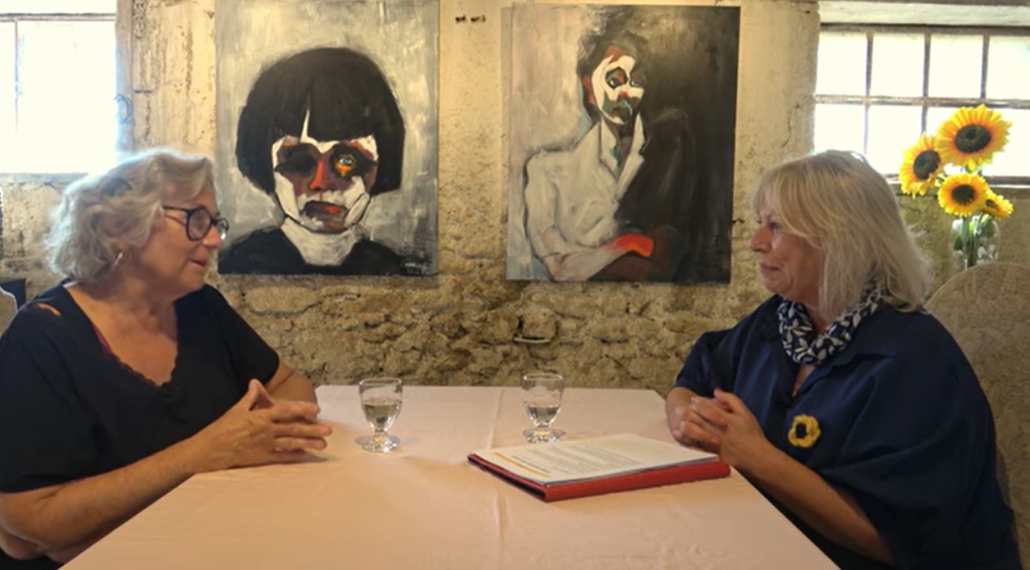
“This is me. I like to provoke.” — Debbie Nijland
Guest(s): Debbie
Transcript
Debbie, welcome.
Thank you for having me. It is a great opportunity.
I am really looking forward to discovering who Debbie is and what inspires you and your artwork. Can we go back to where you came from: Amsterdam? People have an image of Amsterdam—clogs, canals and a relaxed way of life—but what was it like growing up there?
I was born there in 1959, not that long after the war. I was the youngest of five children. I have three brothers and a sister, and I grew up in a very poor family. My father was born and raised in the Jordaan, a famous working-class area of Amsterdam. It is now very fashionable and affluent, but at that time it was very poor.
In the 1960s Amsterdam was full of hippies. It was a very free city. The hippies lay in the streets and in parks such as the famous Vondelpark. I would walk there with my mother and see people lying all over the grass, very relaxed and smoking—and I do not think they were cigarettes. That seemed quite normal to me. There were also many demonstrations at the time.
Amsterdam was in decline then. Many of the buildings that have now been renovated and become fashionable were in poor condition. Today they are mostly for the rich and famous. My own family was quite troubled. I would not call us the Addams Family, but there was a lot of fighting. I was the youngest, and my oldest brother was twenty years older than me.
By 1974, when I was thirteen or fourteen, Amsterdam felt dangerous. I did not go out on my own. My father brought me everywhere and collected me again. My parents kept me very sheltered. Then my father got a new job in the south of the Netherlands, so that was our first move.
I was fourteen and had never really been a rebellious teenager. My brothers and sister were already married and living their own lives in Amsterdam. In 1974 I moved to Etten-Leur in West Brabant, which was a small town at the time. Within a month I met someone, and he eventually became my husband.
The geographical move must have been difficult. We have many Dutch friends here now, and I know there is a big difference between the north and the south.
In Amsterdam I could not do anything because of the fear and the danger. I had already seen and experienced a great deal, including abuse. In the south, although it has changed now, I could go to school parties and visit friends on my own. I had my first boyfriend and my parents accepted that. For me it was a kind of heaven. Amsterdam was supposed to be the city where everything happened, but for me nothing happened there. Everything happened in the south of the Netherlands.
Were you creative at that age? Had you started making art?
Yes, I took some drawing lessons, but many things kept me from pursuing it. My relationship was important—puppy love, perhaps—and my parents had never encouraged me to study art or pursue any other education. I had many dreams, but I went to work in a bank.
I cannot imagine you working in a bank!
I did. I worked as a cashier behind a counter where people came to withdraw money. I was only about sixteen. I later worked for the well-known construction company Boskalis, doing various administrative jobs. None of it was inspiring, and I was never satisfied—with the relationship, the work or probably anything else. I never had the courage to stand up for myself, and I think that is one of the biggest mistakes you can make.
I think women were almost trained to follow a particular path. You could explore a little, but then you were expected to get married, settle down and have children.
I did have two wonderful children, so it was worth it. That part of my life brought me my children. I also became quite a successful breeder of Old English Sheepdogs and travelled all over the world with them.
They are known in the UK as Dulux dogs because they appeared in the paint advertisements. How many dogs did you have?
I had four at home and another twelve living with foster families. When I needed them for breeding or an exhibition, I collected them. I had agreements with the foster families to ensure that the dogs remained in perfect condition.
Did you go to Crufts, the famous dog show?
Yes, although at that time we were not allowed to take our own dogs into the UK because of the regulations. I visited shows in London and Birmingham. I bred world champions, including Danish, French, international and Dutch champions. But it could be an unhealthy world. People became jealous, and some would even hurt other people's dogs.
I eventually decided to stop. That point came at exactly the same time that my husband decided to find another young woman, who happened to be my niece. Everything suddenly fell into place: I stopped breeding dogs and concentrated on my children, who were around ten, eleven and twelve.
You had reached a major junction.
Yes, but I took the wrong turn. I chose to try again and continue the relationship. That was a huge mistake, although we have all taken wrong turns. I thought it was best for the children. Women were programmed to keep trying, and I was also financially dependent. It is easy to call that stupid now, but it was the reality at the time.
As a mother who has been in a similar situation, I understand. You cannot simply pack a bag and walk away when you have children. The consequences affect everyone.
Now that I am older and wiser, I can see that I could have moved in with my parents or friends, or even lived under a bridge if necessary. At the time, however, I thought I needed the relationship.
I began taking art lessons seriously in 1993. The difficult junction in my marriage came in 1997, but by then art was already becoming an important part of my life. I attended six or seven lessons a week with different artists because something had been ignited in me. It was almost like a disease. I was eager to learn about materials, artistic directions and art history.
I continued taking lessons, and in 2008 I decided it was finally time to do something for myself and attend an academy. I was accepted into the five-year Higher Degree Painting programme at the IKO Academy of Fine Arts in Hoogstraten, Belgium.
Then, in 2009, the divorce finally happened. There was another woman—not a better woman, simply another woman. It was an extremely difficult period, even though I knew divorce was the right decision. You still feel that you have failed and let your children down. My children were already in their early twenties, but it was still a major upheaval for them. In some ways, it may be easier for children when they are two or three than when they are twenty or twenty-two.
Did that painful period and all those changes begin to appear in your art?
I think all my experiences came through in my work: Amsterdam, the freedom that existed then, my experiences with men and marriage, and everything I learned about women and how their lives developed. Life may appear simply to unfold, but there are thousands of years of history behind the position of women.
You attended my lecture here in January 2025. It began with the history of women going back to around 40,000 BC. When you understand that history, you can see how those layers were built up very slowly. I have strong opinions. I do not necessarily call myself an activist, but I believe these issues are important.
The lecture explored those patterns. We are both happily married now—to wonderful men—but this is not about attacking men. It is about giving women a voice, creating opportunities for them and recognising patterns inherited from the past.
Recognising those patterns is the most important part. At a party or when visiting someone, I sometimes have to remind myself to keep quiet because a woman with strong opinions can quickly be described as aggressive or anti-man. I am not anti-man. I love men, but I do not accept men who oppress or abuse women.
Some people reduce the discussion to an argument about men, but it is really about liberating women and recognising what has happened over hundreds of years. The podcast is also a voice. Kim and I want to hear women's stories: how they arrived at this point, which challenges they faced and what they had to overcome. Every woman has a story, and I believe it should be heard.
I agree.
Your art is not always easy to look at because it challenges the viewer. The first painting of yours that I saw concerned the now-famous French case in which Gisèle Pelicot's husband drugged her and allowed many men to assault her. The moment I saw that painting, I was in tears, and it still makes me emotional. That is an extraordinary ability for an artist to have.
People sometimes imagine French art as a landscape or someone painting sunflowers in a field, which can be wonderful. Your work, however, challenges people to their very core. Let us look at these paintings. Who is this woman?
Both paintings are of my mother. During the war she had to live in hiding, rather like Anne Frank. She already had a child, my oldest brother, who was born in 1941. My mother was born in Friesland in the north of the Netherlands and went to Amsterdam as a young girl.
She died a long time ago, and I never asked enough questions. I am not even certain exactly how old she was when she went to Amsterdam—perhaps four, five or six, although she may have been older. Her mother remained behind. My mother was one of twelve children, and only two of them had the same father. It is an extraordinary story, and I wish I knew more. Who took her to Amsterdam, and why? It was part of my life, but it was never discussed, so I accepted it as normal.
By the age of eleven she was working as a cleaner for a family. She had only seven years of schooling. She was a very intelligent woman but had no formal education. She married at seventeen and had her first child at eighteen. Then the war came.
That is why I painted only one eye. My husband Peter asked why I had given her only one eye, especially because she had such beautiful blue eyes. I told him that one eye could see more. Painting two eyes would not necessarily say anything more.
The pictures are very intense. That is a gift and a skill, although I cannot imagine it is easy.
Many people like paintings that look nice above the sofa and match the rug or curtains, and I understand that. But if I had to paint that way, I would never paint again. This work is me. I like to provoke—or perhaps challenge is a better word.
Why do I want to challenge people? Perhaps because there is so much pain in the history of women, in art, in my own family and in my own life. People sometimes assume I must be depressed because I paint subjects like these, but I am not depressed at all.
I become depressed when I watch television, the news and talk shows and hear about Putin, Trump and everything else happening in the world. Then I collect images, search the internet and use ChatGPT—I am a modern girl. I combine those sources with old family photographs and assemble ideas in my head.
When I begin painting, it becomes a technical process. The image and colours have to work together, and the painting needs the right impact. I do not stand there crying while I paint. I focus on the technical work.
When did you begin exhibiting and start calling yourself an artist?
I began exhibiting around 2009, 2010 or 2011, while I was attending the academy, gaining confidence and developing my own artistic signature. It was a gradual process. By the time I received my degree from the academy in 2013, I certainly considered myself an artist.
You had moved from Amsterdam to the south of the Netherlands, married, divorced, studied and become an artist. How did France enter the story?
I was alone for several years. I met Peter in 2012. I worked as an art teacher, built my own studio and workshops, and taught many students. I sometimes said to Peter, who had a regular job in the Netherlands, “Imagine living on a little mountain in France while I spend my days painting.” It was only a dream. We did not have the money or the property, Peter still needed to work, and an artist does not normally earn enough to save for a second home in France.
Then COVID arrived. I almost have to whisper this because it was a terrible period and many people lost loved ones, but for me it also brought something positive: quietness. I worked incredibly hard. There were no lessons or other interruptions, and Peter worked from home. His employer discovered the benefits of remote working.
At the time, Peter and I were living together in a trailer, where we stayed for four years. It was a marvellous period. I worked outside under a small shelter while Peter did his job inside the trailer. I liked joking that we were “trailer trash”. Apart from all the COVID-related hardship, it really was a wonderful time.
When the pandemic receded, I asked why it should matter whether Peter worked from home in the Netherlands or in France. At first his employer was hesitant, and there was still the financial question because I did not earn much from my art lessons.
Then somebody came into my life who, in earlier times, might have been called a patron: somebody willing to support an artist. This person made it possible for us to search for and buy a home in France.
An angel?
A modern angel, because we do repay the money. Everything was arranged properly in a notarial agreement and put on paper, but this person was still an angel. It gave us the opportunity to begin looking. We wanted a very small house with a large barn for my art.
This is certainly not a tiny house. How did you find the Berrichon region?
We originally wanted to move to Burgundy, particularly the Nièvre and the southwest of the Morvan. I had spent many holidays there and had painted there many times, so I was completely in love with Burgundy. After COVID, however, many people from Paris and the Netherlands were looking for houses there. Prices rose, estate agents were difficult to reach and properties were often sold before we could view them. We had to widen our search area.
Peter found this property online. The listing showed only the barn, and it looked terrible. The photographs made it appear as though a small chemin or road ran between the house and the barn. I dismissed it because the pictures were so bad.
On the day we came to view it with the immobilier, there was thick fog. We could barely see twenty-five metres. The agent told us it had the best view we would ever see, but we could not see anything. Peter immediately liked the property. I imagined three nuclear power stations hiding in the fog behind the house and remained unconvinced.
That day we were supposed to drive back to the Netherlands, but our car broke down. A recovery vehicle took us to a garage about a hundred kilometres away. The next day the car was miraculously repaired and the sky was clear and blue. Peter suggested returning to the property for a few hours before driving home.
We did not have another appointment, so we quietly went back and stood on the hill. I immediately began to cry. The view was stunning, and I said, “I want to live here.” It was love at first sight. The bidding began, and everything was agreed within a few days.
We did not realise how much work was involved. The property has three and a half hectares, two barns and two gîtes, and a great deal needs renovating. During the viewing we looked only at eye level; we did not look upwards at the roofs. We were in love, and when you are in love you do not see anything else.
We took the big step and moved to France. We began repairing the house, the gîtes and everything else we could manage. There is so much work that we will not complete it all in our lifetime because it would cost too much, but that does not matter. We are extremely happy here. Perhaps we need a crowdfunding campaign for poor artists!
You once told Peter that you wanted a house on a hill. This area is not especially hilly, but your house is on one of the few elevated places. Once the fog cleared, there were no nuclear power stations—only fields. Perhaps you were meant to be here.
I definitely think so.
You now offer art retreats, your work is visible throughout the property and you have brought something important to the area. When your exhibition opened a few weeks ago, the mayor attended, as did the vice-president of the local area and the local press. You have become part of the community. As we often say on the podcast, the community will not necessarily come to you; you have to go out and become part of it.
We organised the exhibition as a team because one person cannot do all that work alone. We worked with Frank den Os, Ivo van Woerden and Jack Lokhof, and invited Monique van Berkel from the Netherlands. We did it together and already have ambitious plans for next year.
The change in the audience has been wonderful. At our first exhibition most visitors were Dutch, with a few English people, a couple of Scots, an Irishman and only a few French visitors. This time most visitors were French, with fewer Dutch visitors and almost no English visitors. Attracting local French people is very important to us.
Many French visitors said they do not often see this kind of contemporary art presented in this way. We have tried to create a professional exhibition space and present the paintings, drawings, collages and ceramics to a high standard. Visitors are free to like or dislike the work, but we want to challenge them, encourage growth and give them a reason to return.
Living here also means missing your children and grandchildren terribly. You gain a great deal, but you lose something too, and that is extremely difficult.
You know exactly what I mean as a mother and grandmother. We are lucky to have FaceTime, but it is not the same as being able to smell, touch and hold your grandchildren. We return to the Netherlands every eight to ten weeks, but the visits are always too short. You miss the first day of school, the first swimming lesson and the first word. That is the reality.
Sometimes you also miss your old friends. You have to build an entirely new world here. Your old friends do not know what your daily life in France is like, while your new friends do not know your old life. You have to build a new shared history. The old history does not disappear, but it becomes another chapter. Here you develop new roots, friendships and relationships, and those are very precious.
We often laugh that most of our friends here are Dutch. I came to France to learn French but find myself speaking Dutch to the dog, saying, “Nee, nee.” You meet fascinating people, and French is a beautiful language, but it is extremely difficult to learn. I practise with Duolingo every day and am improving, but expressing yourself is still hard.
You can talk about the weather or say how nice something is, but making a joke is much more difficult. None of my jokes seem funny in French; nobody laughs.
I recognise that. At the Super U meat counter the other day, the person serving me made a joke because I had not asked for the ham to be sliced. She asked whether I wanted the whole ham, and I suddenly realised we were joking and laughing together. It felt like another step forward: I can now joke at the meat counter. I have probably made that counter famous because I mention it so often.
Your art, your story and everything you do challenge and inspire women. I also love the way you introduced us to this community. If you could return to the little girl in Amsterdam who felt frightened, restricted and hemmed in, and show her the woman you have become and what you have created in another country, what would you say to her?
I would like to say I have no regrets, but I do have some. Nobody encouraged me, although I must also accept some responsibility myself. I was a very good student but never had the opportunity to pursue higher education. I would have loved to study law, politics, criminology or forensic science. I could have studied for years and gone to university, and I regret missing that opportunity.
People say you can study at any age, but I am sixty-seven now and have to be realistic. Nobody is waiting for a new lawyer of my age.
Never say never!
I have found another way to give women and women artists a voice. My work concerning Gisèle Pelicot is one example. I now use the abilities and opportunities available to me.
I think you underestimate the voice you have because you did not receive the formal education you wanted. Your voice comes from within you and is expressed through your art.
It has been an absolute pleasure interviewing you. We could talk, laugh and cry for hours. Thank you for sharing your story. We will include all the links so people can discover your work. Thank you so much, Debbie.
Thank you, Jane, for giving me the opportunity to be here and for giving me confidence. Thank you.
Starting over in France gave artist Debbie Nijland the chance to turn a long-held dream into everyday life. But the journey to that home on a hill began decades earlier, with a little girl in Amsterdam whose ambitions had little room to grow.
In this episode of Sunflowers Stories, Jane sits down with Debbie for an honest, warm and often funny conversation about creativity, divorce, finding confidence and building a life that feels like your own. Together, they explore what it means to claim your voice after years of putting other things first, and the joys and compromises of making a home in another country.
Finding the confidence to call herself an artist
Born in Amsterdam in 1959, Debbie was the youngest of five children in a family where money was scarce. She remembers the freedom of the city’s hippie culture alongside a childhood that felt much more restricted. Moving to the south of the Netherlands at fourteen opened up a different world: friendships, school parties and a relationship that eventually became her first marriage.
Creativity was already there, but encouragement to pursue it was not. Debbie entered working life through banking and administration, while her artistic ambitions remained in the background. Marriage, motherhood and an international involvement in breeding and showing Old English Sheepdogs filled the years that followed.
In 1993, she began taking art lessons seriously. Her appetite for learning grew, leading her to explore different materials, techniques and the history behind the work. By 2008, she decided it was time to give her own ambitions more space and entered an art academy.
Divorce followed in 2009, bringing another painful turning point. Debbie speaks candidly about financial dependence, trying to keep a marriage together and the understanding that comes with hindsight. Alongside that upheaval, her confidence as an artist continued to develop. Graduating in 2013 marked an important milestone in recognising the identity she had worked to build.
Starting over in France: the house on the hill
When Debbie met Peter in 2012, a new chapter began. She was teaching art and developing her workshops, but another dream stayed with her: a little house on a hill in France, with space to paint.
During the pandemic, Peter’s experience of working from home opened up possibilities they had previously struggled to imagine. With financial support arranged through someone willing to help an artist, they were able to begin searching for a property.
Their first choice was Burgundy, but rising prices and missed opportunities led them to widen their search. A property in rural Berry caught Peter’s attention. Debbie was less convinced, particularly when their first visit took place in fog so thick that the promised view was invisible.
Then their car broke down, delaying the journey home. Once it was repaired, Peter suggested returning to the house before leaving France. This time, the sun was shining. Standing on the hill and looking across the countryside, Debbie knew she wanted to live there.
Starting over in France brought more land, buildings and renovation work than they had imagined. Yet Debbie is clear about what matters most: they are extremely happy in the home they have made together.
Art, women’s voices and the meaning of belonging
Debbie’s paintings ask viewers to engage with women’s experiences, power, history and pain. She wants her work to provoke thought and feeling. In the conversation, she explains the personal meaning behind portraits of her mother, including a painting with just one eye: an eye that had already witnessed so much.
Her work also creates connections. Through exhibitions organised with fellow artists, Debbie is helping build a creative space that increasingly attracts French visitors. For her, becoming part of the community involves collaboration, participation and giving people a reason to come together.
Starting over in France also means living with distance. Debbie talks openly about missing children, grandchildren and the everyday milestones that visits and video calls cannot fully replace. New friendships are precious, but shared history takes time to build.
Listen to the full episode for a conversation filled with humour, honesty and reflection on finding your voice, following a dream and making somewhere home.
Connect with Debbie
- Debbie Nijland — artwork and gallery
- Art retreats, painting holidays and workshops
- Domaine Lavau — accommodation in Néret
- Debbie’s blog — their life in France
- Email: debbienijland@gmail.com
🌻 About the Sunflowers Podcast
The Sunflowers Podcast is dedicated to women over 45 who are reinventing their lives under the French sun. Hosted by Jane, we share authentic stories of relocation, integration, and personal growth. Whether you’re dreaming of a French maison or already navigating life in the Hexagon, this is your community for inspiration and practical wisdom.
🔗 Free Resources & Links
✨ Support us
If you enjoyed this first show of the Sunflowers Podcast, please Subscribe on Youtube and hit the 🔔 icon so you never miss a new story. Leaving a comment and liking the video helps more women find our community!
If you want to support us more in continue creating podcasts, you can buy Jane a sunflower 🌻
Want to contact Sunflows Story with any questions you have? Use our contact form on our homepage.
📺 Sunflowers Podcast Playlist

