S01E06 A New Life in France: Taking the Leap of Faith
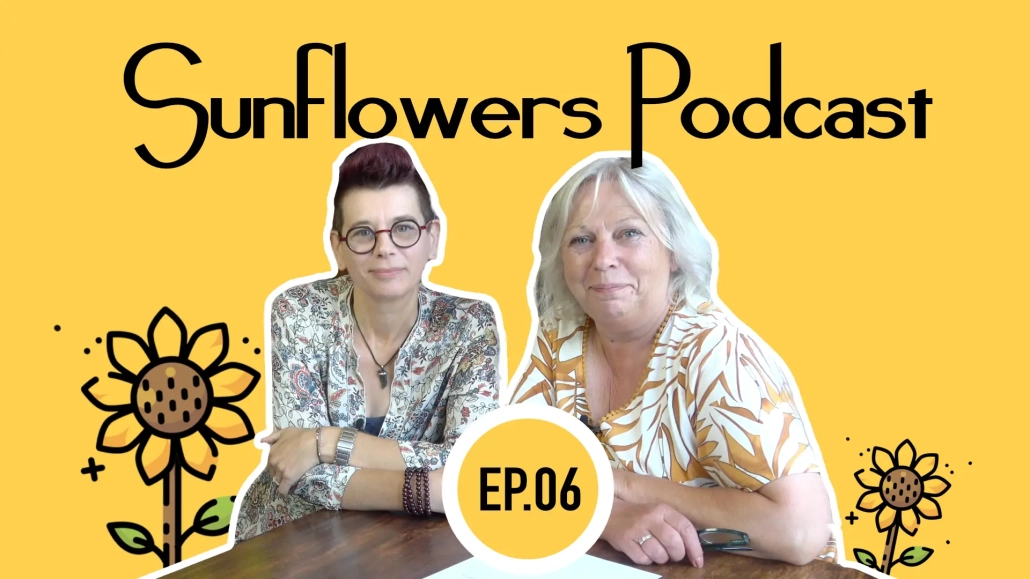
Sometimes the hardest journeys lead to the most extraordinary chapters
Guest(s): Cat
Chapters
0:45 - Life Before France: From UK Marketing to a Holiday Home
3:20 - The Early Days: Dial-Up Internet, Renovation & Working Remotely
7:10 - Language Barriers: Sign Language, Automated Calls & Berrichon Accents
12:00 - Rural French Pace: Energetic Slowdown & Grieving Your Past Self
16:45 - Community Integration: Building a Website for the Mairie
21:15 - Adapting to the Climate: Heatwaves, Shutters & Local Customs
24:30 - Uninvented Life: Spiritual Growth & "Work to Live" Mindset
29:10 - Women's Transformation: Shedding Masks & Redefining Identity
33:40 - Looking Back: Advice to 15-Year Younger Cat (Ask for Help)
Transcript
Jane: Welcome to another episode of Sunflowers Podcast. Let me start again by thanking you all for all your likes and your shares. And just to let you all know that we do have a new website, which Kim, who's always behind the camera, has created for us, and we will put that in a link if you could follow through. We will be doing a newsletter in the future, so if you'd like to add your email to that, then we can add you to an email list.
Today, I'm really looking forward to our new guest. We have Cat with us today. Hello! This has been very exciting for me. Cat is quite a celebrity in the Facebook world; she has 39,000 followers. So when I get to that stage, then I'm going to be very excited.
I'm going to let you introduce yourself first. Cat, tell us all about you. Who are you?
Guest: Well, I'm Cat Knott. In the world of work, I'm basically a life coach, but I work primarily in the spiritual field, intuition, connecting with energy, and all of that sort of stuff—which has been a massive evolution finding its way into my world. But there you go.
Jane: Fantastic. Okay, so we're going to start where we always start. How did you get to France? Who were you before you got to France?
Guest: Oh god, it's really hard to say. I mean, I've been here more than 15 years now.
Jane: Wow.
Guest: So, it's not a new transition for me to be in France. I was self-employed before I moved to France, so I didn't have that big crushing blow from not having a workplace to go to and people around you all the time. I'd already kind of transitioned into that. But moving here, there's such a shift of identity and everything when you move to a different country.
In real terms, I was self-employed in the marketing realm. I was working for a publishing company and a promotions company. I had really big clients that I used to work for, built websites for, did promotions for, wrote PR for, all of that sort of thing.
Then, we never intended to actually live here. It was just a case of buying a second house, doing lots of renovation on it, and then you spend so much time falling in love with the place and being here. Then it became a question of: where do I really want to be?
So yeah, lots of changes over the years. I think one of the things that we both work in is recognizing that life is a complete evolution and it never stops. It's a very fluent, changing process. There isn't a "me before" and a "me after." There's a "me" that's been working my way to here, just as you've been as well.
Jane: Yeah. So, it started off as a holiday home.
Guest: Started off as a holiday home, yeah.
Jane: And how long did you have it as a holiday home before you...?
Guest: Oh, it was a couple of years. I couldn't tell you exactly. But we did all the hard work on it. We did the whole buying an old French property and then starting to work on it. With everything that you do, you then find another three things behind the thing that you started doing that you didn't know were there.
The thing about being here when I came across is that it was before Google Translate existed, and we still had dial-up internet in the house when we moved here.
Jane: Yeah, I remember those days.
Guest: So, it was a completely different time. I see people moving here now, and I see all of the amazing things that are available to help with integration—the Facebook groups, the communities, and all of that stuff. It's just amazing what technology has brought in that has made life easier for being here, even though it may not feel easy. I think it's a case of embracing all of this that is available to you now.
Jane: Yeah. And I think we personally forget that, because when I first came out here 3 years ago, I was still running businesses back in Scotland and I just assumed it was fiber. But actually, our village was the first one in the Indre to get fiber. I thought, "Thank you, God, for that," because it integrated so quickly in two or three weeks. I don't know how I would have coped if we hadn't had that.
Guest: There was one stage where the village got broadband—which was tiny broadband compared to what you can get now—but that was the moment where it was like, "Okay, it's a possibility." Because everything up until then, you were working on dial-up, and I was in marketing, so I needed the ability to work. Once that level of technology came in, it opened a few more doors and a bit more possibility of what life could be came into play.
Jane: So when you made the transition to come here permanently, you continued working remotely?
Guest: Yeah. I looked at what parts of my work could transition, and how to make that shift from actively commuting up and down the country, seeing clients all the time, being involved in businesses, training, and all of that stuff I used to do.
Jane: 90% of that couldn't come with you.
Guest: No, couldn't come with me. So it was a question of: what are the bits that could come with me? At that time, the bits that could come with me were building websites and business development. I was lucky that I had a couple of clients in the UK that said, "Well, we'll continue working with you in certain ways and in a smaller capacity."
But that version of me that said, "Right, I can do this. We can make it work." That's the part that I recognize in so many people that move to France: you just grab onto the bit that is a possibility and you go with it, even though you can't prove it's going to work in the end. You've just got to take that leap of faith.
Jane: But I think if you've worked for yourself or you're entrepreneurial, you've got that in you anyway.
Guest: Yeah, I think you have to.
Jane: And there's definitely two different groups out here. There's people that have come out to retire—and fantastic, my intention was to come out and retire, but it didn't work out. So then you start having a scan of what you can do and developing that further. That shows a certain type of resilience. I remember suggesting to my husband, "Maybe we could open a restaurant out here," and he was like, "No, that's an absolute no. We've done that and that's gone." And he's absolutely right.
So you've arrived. Great. You've decided what you're going to do. You've now got broadband, which is great—
Guest: Now got a bit of broadband.
Jane: You don't have to listen to the dial-up noise in the background! How did you cope with the language? How did you start making friends?
Guest: Well, when you're self-employed, the edges blur a bit anyway. My edges were already blurred from being self-employed before moving here, so the business part of it was never separate. I made my friends through the work that I did quite a lot of the time.
But you have to recognize that you come over here with a plan, and it goes out the window the minute that you arrive. You can only ever have a broad idea of what it's going to be. I moved from working in the London area to central rural France, where I had no idea that the internet was not really a thing over here! So I came out with a plan of building websites, and it was just like, "Oh, they don't do that."
So as we know, this whole evolution journey is: you come up against something, you try it, then you have to pivot, try it again, pivot, and find a different way. Every single person that's moved country has that in them. I don't think we would have the capacity to do it unless we had that resilience and ability to go, "Okay, let me keep going, let's keep trying, let me keep moving on."
Jane: Yeah. And I can't imagine—when you're saying you just got broadband—being able to do renovations without YouTube!
Guest: No, we didn't have that!
Jane: I've learned how to point through YouTube! I've fit double-glazed windows because we've watched a thousand hours of how to fit a double-glazed window.
Guest: I know you're talking about pointing as in rendering, but that was how we got by! I literally would go to a shop with a dictionary. We knew the terms for the things because we'd found them in the dictionary. Then we would go to the shop and I learned very quickly to say, "Can I show you?" I would literally take somebody and point at the things, gesture, smile, and all of that sort of thing. So it was fun, but it was terrifying at the same time. But life is the same: fun and terrifying kind of work in the same vibrational space.
Jane: Yes! At the beginning, you sit out in the car and practice, practice, practice. Then you go in and you speak, and then they answer you and you're like, "Oh, I don't have an answer for that!"
Guest: The worst thing for me was—and still is to a certain extent—when the automated telephone systems came in. My French wasn't very good at that time, so you'd ring and get "Press 1 for...". You'd put the phone down and write down in your best bad French what you thought they'd said to you. Then you'd try to understand what option one was, and then you'd ring back and listen to option two and write it down again! It's that ability to laugh at everything, I think, that keeps you going.
Jane: Oh, you need to have a sense of humor.
Guest: The ridiculousness of what you've thrown yourself into, you know?
Jane: Well, you're high-fiving each other because you've managed to do a phone call!
Guest: It's honestly so funny so many times. We've probably gone off on a tangent, but I think with everything like that, you don't know what you don't know. You land here and you do not know what you don't know. One thing I would say to everybody that is coming across is: just talk to real people.
Jane: Yes.
Guest: Ask for help, and prepare to adapt.
Jane: Yeah. And the plan you're coming out with...
Guest: Know that there's a lot of things that you don't know you don't know. And be kind to yourself. You have to be really kind to yourself because there is absolutely no way that you can prepare for everything that's going to come.
Jane: Oh, no. The things you think you've researched—we do research, but then the things you haven't researched are the things that catch you out. You're suddenly thinking, "It never even entered my head that I would need to know this."
Guest: Absolutely. On an energy level as well, one of the things that we have to be aware of when we're talking about integration and finding your feet is that moving to a rural area absolutely wallops you.
Jane: Oh yeah.
Guest: Because it's slow and steady, and it has no excuses for the fact that you want to work at your speed—where you've come from a big city or a big town and everything happens fast. There is no excuse for that over here, and you just have to shed it really quickly. It can be absolutely brutal. The energy here makes you slow down.
Jane: I find that really difficult. I was used to just picking the phone up or going to do something. We've talked about this many times: things grinding to a halt between 12 and 2. But you know what? I would really miss that now. I would find it hard to go back up into fifth gear.
Guest: I know so many people that have just kept fighting it.
Jane: Yeah.
Guest: I think that's the hard thing: you just have to settle into it. It's not even necessarily the cultural thing—the culture is slow, with the two-hour lunch and recognizing that everything stops for two months in the summer and all of that. But on an energetic level, it just slows you right down. You have to walk and do everything at a pace that you're not used to. It sheds all your layers, all your facades, and takes every identity that you came along with. You just have to spend a period of time going, "Oh my god, who am I now? I'm here."
Jane: Very few of us come out at this age with our children. So as we've talked about before, suddenly you're not the mother you were—you're still the mother, but you're not the grandparent or mother in the same daily way because you're not there. So then you have to start living with the person that's sitting here, and that can be very difficult and very painful. The only person that goes everywhere with you is yourself!
Guest: Exactly!
Jane: Suddenly—and I've talked about this before—I went out a few weeks ago into the garden and it was peaceful and quiet, and I was absolutely terrified. I had to come back in and say, "Raymond, I don't like this." That's because I've never sat in that peace and quiet. I think that's the kind of stuff that sometimes people miss. We were joking when you said, "How long have I been here?" and I said, "Three years, I'm just out of the depressed stage." I don't mean you become heavily depressed (some people do, obviously), but you do go through a period of loss that you need to readjust to. It's grieving—grieving who you were.
Guest: Yeah. Because suddenly you're in a situation where you literally know nothing. I know that sounds ridiculous to say, but it's true.
Jane: No, it's absolutely true.
Guest: You're moving into a situation where all of that underlying cultural identity that you've had your whole existence is not here. It's gone. You can't go to your neighbors and talk about the TV program you watched as a kid. All of those little cultural language pieces fall away because you don't know who the people are that they're talking about on the telly. You don't know any of the celebrities or the cultural history. Those roots of "who am I?" literally shatter.
Jane: I think you almost have to come out with a pioneering spirit, as if you just landed in America and you've got to go and build your house and do all this stuff. We are pioneers, and especially to come out in the later years of life and then refind yourself is quite daunting. So you're here, you've arrived, your house is complete...
Guest: 90%! Well, we've actually moved.
Jane: You moved to Indre?
Guest: Yeah. So, I've been here over 15 years now. Even if you are moving in your 30s—like I moved here in my 30s—or if you are moving into a different area in midlife at the age that I am now, you have to remember that you've still got a lot of life left.
Jane: Yeah.
Guest: You can come out thinking, "This is what my life's going to look like," but you have to give yourself that permission to say, "It may not feel like enough in a few years." You think you're putting a plan of "forever" together, but "forever" doesn't exist—it only exists until you become the next version of you, which life brings. That's just the way it is.
Jane: So how did you integrate into the community? How did you find that? Because obviously, as you're saying, there were no Facebook groups, there wasn't Sunflowers, there weren't all these kind of things. How did you integrate?
Guest: Well, I found people mainly through the work that I was doing, and people introduced me to other people. I think you can look back on relationships that you made at the time, and I look back now and think they were really precious relationships. But life moved in ways, and I wasn't the me that I am now back then.
Again, you have to be kind to yourself that sometimes you end up making mistakes with how you react in the world. We all do the best we can with the information that we've got at the time. I've got some really precious memories of friends that I look back on, and I feel a bit sad that I didn't realize at the time how precious they were. But life moves on, and we end up meeting new people.
As technology evolved, you end up moving into a situation where Facebook connects you, and you end up with conversations like, "Oh, I'm just down the road from you!" Again, make sure that you are reaching out. You have to be part of the community, and don't ignore the part of you that needs community and people.
Jane: Yeah. And certainly with Sunflowers, the community is growing. We've got about 100 active members, but we've got 350 plus on it. I know that does make a difference to people. Even just the WhatsApp group—just people that are maybe on their own keeping in touch every day and saying, "I'm up, I'm alive, I'm here, I've walked the dog." So community is huge. Was your village quite good? Was your salle des fêtes quite busy?
Guest: Yeah. The salle des fêtes and the communities here are one of the magical things about France. Whatever village you're in, the community works together. I got an "in" in my village because I built a website for them 11 years ago. I made the offer, and at that point I could barely speak French. I took an interpreter friend with me, and we got by. That relationship built from there, so that was really important.
Jane: You understood the importance of community and actually just turning up and saying, "I can build you a website." That's a gift—terrifying, but it was a gift to them and they appreciated that.
Guest: And that opened the door for the community to say, "This is the girl that built..." You get reach somewhere and take it from there. You do have to make that bit of effort.
Jane: I've got a wee neighbor who's very... and we've talked about this again, because in the Berry region, the Berrichon language is a bit different to the French you're taught in school or what they speak in Paris. I would link it in the Scottish way to the Doric—the language spoken up in Aberdeen that none of us can understand! My wee neighbor was very much Berrichon, and she is an absolute character. I'm very fond of her, but she's determined I have to speak Berrichon. Then I'd see her in the shop and she's like, "No, they don't understand me because it's Irish!"
Guest: I had to go into hospital for an operation quite a few years ago now. I remember the nurse coming in and talking to me, chatting away, and she just looked at me and went, "You've got a very beautiful Berrichon accent." I was like, "Is that a good thing or a bad thing?!" So, yeah!
I picked up French a lot by listening. I learned my French commuting, driving up and down the M1 with CDs and repetition. My learning style is through listening and having a go, really.
Jane: Yeah. I think you just have to, even if it's not in the right order all the time. You get the gist. But you do pick up the accents and the words that perhaps aren't very appropriate, but people want to teach you those words first!
Guest: One of the girls that I worked with taught me "merde," and two days later I was standing at the petrol station. There was a wee French lady who couldn't get the pump to work, and I heard her saying "merde." So I knew what she was saying! You can look that one up. It made me laugh, and because I laughed, she laughed. I still had UK plates on my car, so she obviously thought I didn't understand, and then she realized I did!
So yeah, community is very important, and you did a great job of integrating.
Guest: I wouldn't say I did a great job, but in hindsight, you look back on everything and recognize where you could have done it better. That's the story of our lives, isn't it? But I would say that anybody coming over now: really make sure that becomes a very important part of what you do. Especially moving to a rural community, respecting their ways is very important, and giving the Mairie their place because they're very well thought of and have to be respected. I think that's very, very important.
Jane: I think some people miss the importance of that. I run everything past Sarah. I just send it away going, "Is this okay?" But then you get the respect back from that, I think.
Guest: It's recognizing that you don't know what you don't know. The Mairie here really is the first point of contact for anything that you're not really sure about. If you can be brave enough to go and have those conversations, the receptionist in the Mairie is generally really lovely. They're like the gatekeepers who say, "Go talk to them or go talk to them." It's a lovely part of living here, really.
Jane: Yeah, and I think it gives you a real sense of community. The lady in our Mairie's office is great because sometimes I've gone in and I've been filling up with tears, and she's like, "It's okay. Steady, steady, S.V.P." And I'm like, "Yes!" Because sometimes it can be a bit much.
I still see people that have been out here quite a while not really grasping how to make that work. It's even down to wanting to paint: technically, you have to get the okay for the color from the Mairie. I personally don't see anything wrong with that, but sometimes I hear people kick back a wee bit, and I think: don't kick back. Just go with the flow, give people their place.
Guest: You've got to recognize that you are in an entirely different place. You've brought yourself here, but you can't bring your old way of working here. You have to settle down into knowing that you're a guest.
Jane: Exactly. You are a guest in somebody else's house, and recognizing how lucky we are that we are actually welcomed as guests here—especially the way the world is going at the moment. Really recognize how lucky we are with the lives that we've got. 100%.
So, we're just entering into a heatwave—which is our second one in as many weeks. I think the last recorded one we had two weeks ago was the warmest and earliest heatwave recorded in France ever, and we're about to enter this next one. How did you find adjusting to the weather when you first came out?
Guest: Well, when you're self-employed, you're indoors quite a lot. So you still have that whole transition of, "I've got weekends and evenings to do the things that I'm doing." Yes, it's lovely being self-employed because you can take the odd afternoon off to do whatever you fancy, but I just felt like this part of France was very much like where I'd come from—just a little bit warmer in the summers and colder in the winters. That's just how I navigated it. It's not massively different, though it is getting warmer for sure.
Jane: It is getting warmer, definitely. I think we're expecting 41°C on Friday. So for me coming from Scotland, it's a challenge!
Guest: I just see it as more extremes of everything. But you adjust. It's that recognition again of: what do the locals do? You learn really quickly that the locals close the shutters during the day and open them up in the morning. Once you've got that sorted out, you're absolutely fine. But you would never have thought of that on your own!
Jane: Never in a month of Sundays! You think shutters are there for decoration, but they're actually a very practical thing out here, and you could not survive without them. Not all of us have air conditioning, so you need to adapt: a fan and a frozen 5-liter bottle of water sitting in front of the fan! It definitely makes a difference.
Looking back, do you think the skills that you've learned that you didn't bring with you—are you pleased with what you've done? Are you still growing?
Guest: I think we all want to keep growing, don't we? We want to keep becoming something more than what we are. One of the things that happened to me—and I see it happen to a lot of people that move—is that we give ourselves the chance to remember who we are. When those facades, labels, and masks fall away, and the old versions of who we were when we were doing all of that fall away, we start to recognize: what are the bits that really light me up? What are the bits that I want to live for? What are the bits that I want more of?
Then you can navigate from there. That's the beauty of the energy of working in this place: you give yourself that gift by making the choice to move. You give yourself that permission to reinvent. Most of us don't give ourselves that permission.
Jane: No. I speak to a lot of women and they're desperately trying to hang onto the person that they were before they came out here, and that person cannot coexist. You see the women that have adapted—it's being adaptable, realizing that there's probably nowhere open for something to eat on a Sunday. (Although it is improving!) But there's also a sadness with that, you know?
Guest: Yeah, because it's part of life, isn't it? It's that cultural part of the weaving of who you are as a human—the history of going to the Sunday pub and sitting there with a pint and a nice big meal. It's a bit of a shock that it doesn't exist. You can find it more and more now, but 15 years ago, it just didn't exist.
There are only two things that I can honestly say after 15 years that I still miss—and it seems really ridiculous: being able to get a pint of lager shandy, because that doesn't exist at all (you can make it yourself, but sitting in a pub garden with a pint of lager shandy), and a really big coffee! I miss that. Obviously you can still get it from Starbucks when you go to bigger towns, but it seems ridiculous that those are the only two things I miss.
Jane: Marmite for me is a big thing!
Guest: You can get Marmite here now, but when I first came out, I couldn't find anywhere that had it.
Jane: And the other thing for me was Ripple chocolate. A friend came out and very kindly brought me about 16 Ripples, and I think I've eaten two and realized, "I wasn't missing these as much as I thought!"
Guest: It's recognizing that it's not necessarily the things that we miss—it's the memory attached to them. When you first get here and walk around a supermarket, you literally have no recognition of anything. Nothing! You don't realize just how much of life you have memory of and emotional attachment to—even down to packets of biscuits because you had those biscuits growing up at your gran's house. You're wandering around a supermarket and you can feel absolutely bereft because nothing is where you think it would be. It seems ridiculous, but it's so true.
Jane: I think that's why we gravitate to the English section in the supermarket.
Guest: Which again wasn't really here when I first moved, but it is now. There is an international section and you feel that draw to things, even if you wouldn't necessarily have bought them from Tesco back home. You feel like, "Oh my god, it's a thing I can grab hold of!"
Jane: I almost feel like I'm letting France down if I look at that section! So I tend to go past with my trolley scanning it, thinking, "Oh no, I can't." I genuinely try to avoid it. But I do see lots of products coming in now, and companies have set up out here that will supply almost anything you want. But again, I try to steer away because I feel like I'm letting the purpose of coming here down—though that's just in my head! I'm fully immersed and feel I have to be doing the "right thing."
Guest: But there's no "have to." There's no such thing as "have to."
Jane: I think we believe there is! So, you set up Uninvented Life.
Guest: Uninvented Life is the evolution now, and has been for a few years. But again, the business evolved as I evolved. I came out with the skills that I had, which was building websites. But back in the UK, I'd been attached to spirituality, really curious, and seeing energy since I was little. So I had this split life between "professional me" (with the masks and personas) and the stuff that really got me excited.
As I was working on building websites, I recognized that I was drawn more and more to helping people who were setting up businesses here to see their potential and perspectives a bit wider. We'd get into conversations about what bits they really wanted to do, and building a life and business became the juicy parts I liked. So I retrained in NLP, hypnotherapy, and life connection work.
As that was going on, the parts of me connected to energy—walking through the woods in awe of nature, trees, and life—all came together. I started being much more intuitive in the guidance I was giving. I can't imagine what life would be like for me now in my 50s if I were still doing the same work I was in my 30s. I feel like so much would have been left unexplored if I'd stayed doing just that. Moving anywhere gives you that opportunity to explore yourself in a much deeper way, because in the UK and other places, you live to work. Whereas here, you learn very quickly: it's work to live.
Jane: And that's a complete 180 from what we've always been told. You have to be productive, doing something all the time. Out here you learn you don't have to be. You can say, "Do you know what? The sun is shining, I'm going to sit in my garden for the afternoon." But that's a big readjustment.
Guest: It's massive. So don't come out with the expectation that you're not going to go through that transition. Don't live your life with any expectation that you're going to be the same person that you were yesterday, and especially not the same person you were years ago when you got on the ferry and put that plan together of what you thought life was going to be like.
A lot of women here go through this transition as we get older, but when you move to a different country and all that falls away, you recognize how much of your life you've given to other people's dreams. When you're self-employed, you navigate life by your clients' needs: "What can I make myself so I can earn that money, and how can I adjust to make that work?" As women, we're incredibly skilled at being that chameleon that shifts and changes into what you need to be.
This whole conversation you're having—and I'm really glad you're having it with more and more women—is where you come back into: "Who am I when I'm not that? Who have I always been underneath all of that?" That's the transition that most people end up working through. It's a huge shift in identity and who we are. Once you start on that journey and start shedding those layers away, there's no getting off it!
Jane: There's no getting off it! You've started now, you're on it. You've got to keep going, and that's the opportunity you give yourself when you do that pioneering thing: get on a ferry, come here, and start a new life. And you meet some amazing people. You meet people you think, "I wouldn't necessarily sit with you in my old life," but it's very different out here.
Guest: Again, that's that recognition of: am I really being me? That's a big, scary question that not a lot of us ask: "Am I really being me by being in that conversation, by being in that space?" You have to be very brave to ask those questions of yourself.
Jane: We were near our village in Châteauroux and there was a lovely wee bar with live music a couple of weeks ago. A gentleman came and sat near our table. I tend to sit quietly until I work out if the person's French or what—I just assess the situation. Anyway, he listened intently because there were four of us sitting there—my husband's Irish, I'm Scottish, and there was an English couple—and we were chatting a wee bit in French and stuff. Then after about 40 minutes he suddenly said something, and it turns out he was from the north of England! I was like, "That was a bit sly! You were trying to sus out what we were saying!" I said, "We could have been saying anything about you and you understood!" He laughed a lot. But that's a tendency: if I step into a room, I'm just gauging where I am and how much I'm going to have to adjust.
Guest: Yeah, how much am I going to give myself away, is more to the point sometimes!
Jane: Well, this has been a lovely interview. What's next for Cat? What's the next 15 years in France?
Guest: Actually, I'm in the midst of another evolution right now, adding something new onto the business that perhaps we can come back and talk about another time, as it's still in the evolution stage. But I just want to make sure that as many people as possible have the opportunity to recognize the truth of who they are. I'll just keep talking and doing that in whatever way I can. You're obviously drawn to that as well—bringing people together. And, I don't know... just enjoying life really, more and more.
Jane: I always ask this at the end: if you were to go back to Cat 15 years ago—when Cat was maybe a bit nervous about taking the step or not sure—what would you say to her now?
Guest: 15-year-ago me is definitely a very different human being! Interestingly, I have conversations with her quite a lot! But one thing I would definitely say is: make sure you ask for help, and don't hide when you're struggling. Don't sit in isolation. It is hard when you move and you haven't got that community around you, but I don't think we're taught how to be brave and ask for help. It's not a part of natural Britishness, perhaps. Just ask for help and recognize what you don't know. It's completely okay that you don't know everything. Usually within a short period of time, it all works out. It may not be the way that you think it's going to work out, but it will work itself out.
Jane: Cat, this has been a lovely chat. I'm so glad we've had the opportunity, and we'll have you back!
Guest: Thank you, I'd love to! It's been a pleasure having a chat with you. Thank you, take care!
A New Life in France: Taking the Leap of Faith
What happens when you move to France with a plan… and France has other ideas?
In this episode of Sunflowers Stories, I chat with Cat, who has called France home for more than 15 years. What started with buying and renovating an old French property eventually became something much bigger — a completely new life in France.
We talk about those early days before Google Translate and YouTube made navigating French life quite so easy, the realities of renovating, language barriers, making friends and discovering that the career you had before moving abroad doesn’t always fit the life you’ve created afterwards.
Cat’s own journey has taken her from marketing and business development into life coaching, spirituality, intuition and energy work. Along the way, she’s learned a great deal about resilience, reinvention and trusting yourself when you don’t quite know where the road is taking you.
One thing Cat says sums up so much of our conversation:
“You just grab onto the bit that is a possibility and you go with it.”
Sometimes starting again isn’t about having everything figured out. Sometimes it’s about seeing what’s possible, taking that leap of faith and building from there.
🌻 If you’ve moved abroad, reinvented yourself, or ever found that life didn’t quite follow the plan, I think you’ll recognise something of yourself in this conversation.
Watch the full episode and join us for a warm, funny and very honest conversation about life in France, identity, resilience and starting again.
🌻 About the Sunflowers Podcast
The Sunflowers Podcast is dedicated to women over 45 who are reinventing their lives under the French sun. Hosted by Jane, we share authentic stories of relocation, integration, and personal growth. Whether you’re dreaming of a French maison or already navigating life in the Hexagon, this is your community for inspiration and practical wisdom.
🔗 Free Resources & Links
✨ Support us
If you enjoyed this first show of the Sunflowers Podcast, please Subscribe on Youtube and hit the 🔔 icon so you never miss a new story. Leaving a comment and liking the video helps more women find our community!
If you want to support us more in continue creating podcasts, you can buy Jane a sunflower 🌻
Want to contact Sunflows Story with any questions you have? Use our contact form on our homepage.
📺 Sunflowers Podcast Playlist

